ANACHRONISMS, SLIGHT RETURN

Let’s go backwards. Backwards in time, all the way to the beginning. Back to a country that neither of us would recognize, probably. Britain, 1973.
-Was it really that different, do you think?
– Completely different. Just think of it! A world without mobiles or videos or Playstations or even faxes. A world that had never heard of Princess Diana or Tony Blair, never thought for a moment of going to war in Kosovo or Afganistan. There were only three television channels in those days, Patrick! Three! And the unions were so powerful that, if they wanted to, they could close one of them down for a whole night. Sometimes people even had to do without electricity. Imagine!

– Jonathan Coe, The Rotters Club

At the moment, I’m making a concerted – if slightly reluctant – effort to bring my reading up to date. Indeed, if you glanced at the stacks of books currently gathering dust in storage back in the UK (ie. toppling precariously off my Dad’s ad hoc book shelves) you might be forgiven for thinking that the novel ceased existing some time around 1978 (which it didn’t, did it? Might as well have done, though. Arf arf. A little “situation of the novel” humour for you there. Jeez.)

Anyway, after a happy couple of days counting the erections in The Line of Beauty, I’m now onto Jonathan Coe’s The Rotter’s Club. I’m, oh, about 50 pages in, so not much cohesive to report at present, except this: Now, I’ve long held that English culture seems to develop unevenly around a series of time-lags, that there are certain manifestations or practices that persist, long past their appropriate chronology. However, it’s pretty disconcerting to find that Coe’s mid-seventies Birmingham, with its homemade light ale, Big School, prefabs and Black Forest gateau, meshes so easily with the 1990s Hull of my childhood.

DON’T CALL IT A VENDETTA

For Frank Kermode, Zadie Smith’s novelistic gift lies in her talent for “being in the world, for knowing and loving its diversity”. Now, Kermode is, as well as eminent and brilliant, almost ninety, and so I forgive him this oversight, but if that’s the case then what is this?

…which is the shit, man ‘cos it’s like the best thing in the Requiem, and it made me think damn, you can be so close to genius that it like lifts you up… and all these people be trying to prove that it’s Mozart ‘cos that fits in with their idea of who can and who can’t make music, but the deal is that this amazing sound was just by this guy Süssmayr, this average Joe Schmo guy…

(On Beauty‘s Carl, explaining to Zora that much of Mozart’s Lacrimosa was, in fact, composed by Franz Süssmayr.)

STEP INTO MY OFFICE

Hundreds of column inches are devoted to prodding the mystique of what those that write for a living do all day. I’m thinking particularly of those picturesque writers’ profiles in the Guardian Review, often accompanied by a photograph of the writer’s desk: usually Habitat-level or above( or junk shop and artfully worn), framed by postcards and tasteful, not-too-distracting bits of art, perhaps the odd, intruding piece of domestic detritus. Writing, by these accounts, is comfortably incorporated into the day thus: one rises at seven, and is shuffling papers at her desk by eight, exhales the necessary 500-100 words by lunchtime and has the rest of the day free.

Well, in my experience, its not quite like that. Writing for a living (and a very bitty sort of “living” at that), for me, happens along a daily line of most resistance. Its a myopic, time-shrinking thing, marked only by the irregular peaks of hammering a thought into a just-about-satisfactory expression, a half-decent paragraph. It’s pacing, always overdoing the coffee and always falling asleep to the sound of a book (hopefully paperback) falling on your head. The commercial writing I do (which just-about comprises my actual “living”), however, is a wholly different matter. Its nigglingly riddly, but neat in the end, it grants the rewards of sudden expertise on subjects well outside your usual remit. If you’re pervy that way, you might even get a kick out of it.

Thank God, then, for getting out of the house. In Budapest, it’s quite permissible to move your home office operations (that’s a term I use to describe my yellow laptop, “Bigbird”, my pencil case and my kettle) wholesale to the nearest café. This is Central European café culture for you and, happily, it has granted my working day a welcome semblance of sanity – even productivity – at last. After all, under the scrutiny of twenty others engaged in their own similar pursuits, napping, pacing, growling at the computer screen and systematically splintering your arsenal of freshly-sharpened pencils with your teeth doesn’t seem quite right.

In Budapest’s Golden Era, cafés served a similar purpose to the gentleman’s club. Here’s John Lukács’ description from his very atmospheric Budapest 1900:

One could sit for hours over a cup of coffee, with a glass of water frequently replenished by a boy-waiter, and avail oneself of a variety of local and foreign newspapers and journals hanging on bamboo racks. One could send and receive messages from the coffeehouse. Free paper, pen and ink were available there… At a particular table – their reservation was sacrosanct – this or that group of journalists, playwrights, or sculptors and painters would congregate, usually presided over by one or two leading figures… In those frequented by journalists and writers the headwaiters (some of whom were celebrated for their knowledge of literature) kept sheaves of long white sheets of paper available to any writer who chose to compose his article or essay there. These headwaiters were also the courses of tips of the turf, of useful gossip, an – more useful to writers – of extension of credit as well as occasional loans of petty cash.

These days, sadly the fringe benefits have gone, but the spirit’s still there. In fact, I’m pecking away at my keyboard here in Szoda, just around the corner from my apartment in the VIIth. Though the music policy might be called questionable, its a damned sight better than sixth form smokers corner at Café Nero in Norwich.

If, by some mischance, you’ve stumbled upon this post looking for useful information, here are my picks for if you’re toting a decent book, writing your memoirs or have to edit a 10,000 word business report “by close of play today” (yeuch!):

Sirály
Király utca 50.
This place positively invites repurposing into an office, ersatz HQ or a classroom. In the sea of tables upstairs I’ve seen English lessons conducted and regular meetings of what looks (and sounds) like some particularly fiery and well-subscribed Students Union society.

Jelen
Blaha Lujza tér 1-2,
Big and barn-ish, there are nice, big tables here to liberally sprinkle the contents of your bag over.

Ibolya Presszo
Ferenciek tere 5.
Where ELTE students, squirreling away at the library opposite, go for their tea break. Also, strange cushioned around out the back, if you need a lie down.

Muzeum Cukrászda
Muzeum körút 10
And finally, a good bet for afternoons when you’re full of good intentions but know that, in fact, all routes inevitably lead to egy korsó sor, kerem. That is, this place serves coffee, but also booze, cake and is open 24 hours.

By no means feel restricted by this list, however. I’ve seen people, four pints in, whip out their laptops to deal with some urgent correspondence in the middle of a heaving Saturday night out at Szimplakert.
THE RISE OF THE NUTTERS

I’m the kind of girl who enjoys – and, indeed, positively engineers – a time lag in her apprehension of most major cultural events. If there’s fuss and column inches, I’ll generally go away, have a cup of tea, and come back later. I think Joe is the same, he’s rather enjoying the elongated anticipation (or delayed disappointment?) of not being able to view the first part of the Red Riding Quartet Trilogy here in Hungary, which aired in Britain last week.

I’ve been watching The Thick of It, which was first broadcast on BBC 4 in 2005. It’s marvellous stuff – close-to-the-bone, Machiavellian, grotesque – and has me thinking that Armando Iannucci makes a better comedy writer in, say, 1985, than 2005. That’s not to dismiss the very noughties Nathan Barley, whose compelling discomfiture – despite a weak and bitty structure – was upstaged by critics’ and commentators’ hilarious offscreen attempts to find a fingerhold in its scree of irony.

Agreeing with the comments elicited by YouTube clips is generally a bad idea, but those attesting to the perfection of this series are pretty close to the mark, I think. Viewing feels very timely and pertinent in current circumstances, too.

IN THE DISCIPLINE

I’m somewhat ashamed to report that it’s taken me four months to locate the foreign language library here. The process of “settling in” has, let’s say, not quite been an Edith Whartonish whirl of appointments with the local dress-maker – it might better be measured by the friendly acknowledgements won from our local taco-slinger or semi-professional chess player turned barman. In fact, I’ve comprehensively failed at resolving most practical matters, including finding a dentist, a doctor, or a supplier of the kind of vegetarian spacefood I occasionally disgust my boyfriend by consuming.

I got through the first four months with the pile of paperbacks I lugged over here as excess baggage. I’ve exhausted the more diverting of these as bedtime reading , or, indeed, sweated ponderously over the more oblique ones whilst writing an academic proposal – I was almost the woman who had to pay a baggage supplement for carriage of her Christine Brooke-Rose omnibus. I cased Budapest’s second-hand bookshops for a while, but found selection more interesting for the paratextual tales the novels had to tell than anything else: who, exactly, carted The E.S.P. Worm by Robert Margoff and Piers Anthony (a “brain-bending science fiction surprise”) around Europe, decided (wisely) that it wasn’t a keeper and offloaded it at a bookshop behind the Opera in Budapest?

Anyway, the library on Molnár utca comes highly recommended. Its smallish English language section seems orientated towards the fine English Studies programme at ELTE nearby. I came away with a haul comprising Joan Didion’s The White Album (a favourite, favourite prose stylist); a couple of lit crit surveys by that contemporary fiction lot to rouse my ire; a novel by Iris Murdoch that, for all the references to it sprinkled liberally throughout my undergraduate dissertation, you might assume I had already read and Alan Hollinghurst’s The Line of Beauty, which I raced through at lightning speed this weekend. It has had me pondering my own decidedly less luminous intermingling with the Hull commuter belt’s Yorkshire Post cognoscenti as a teenager at a grant-maintained private school, which was more a seven-year blur of chronic embarrassment at provincial Italian restaurants and rugby club discos than cocaine and sodomy in South Ken.

EDUCATE, INFORM, ENTERTAIN

Pssst!

If you, like me, fancy a having a go at Art Appreciation 101, I can think of few better places to start than John Berger’s fantastic Ways of Seeing.

In a week when the view of Britain from here has tested my powers of disbelief (I’ll let respected media outlet Yahoo! News’ “Hot Topics” sum this one up: “Jade Goody, Recession, Royal Family, Crime, Knife Crime”), the soothing, Reithian vigour and properness of this landmark BBC television series has been most heartening.

Watch out for British experimental author Eva Figes making an appearance in a truly 1970s roundtable discussion about the female nude in episode two.

WRITER FOR HIRE

File under: Shameless self-promotion

When I’m not griping about the state of the novel in Britain or poking my camera lens into places it shouldn’t be, I’m a freelance writer, researcher and editor, believe it or not. What’s more I’m currently (ta-da!) available for commission! In a multitude of guises I’ve done lots of web development, web consultancy work and specialist research for business, alongside the usual copy writing, web writing and editing.

You can look at my CV here, or get in touch here.

J

P.S. Edit, link fixed!

REMEMBER A TIME BEFORE TASTE?


…Before our buildings went up with vectors shamphered, plate glass smoothed, lighting recessed.

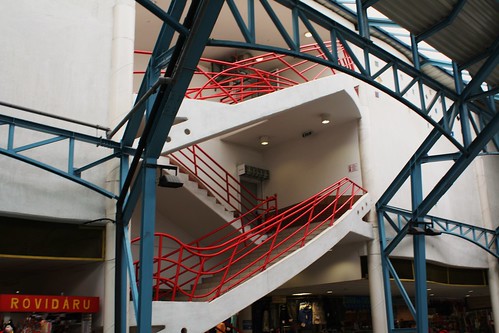
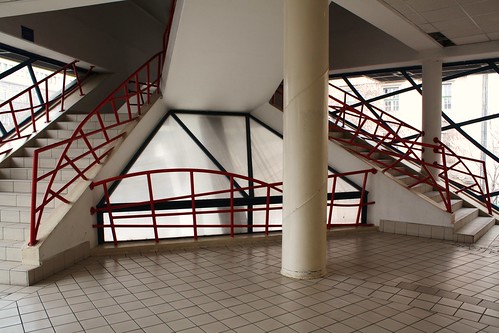
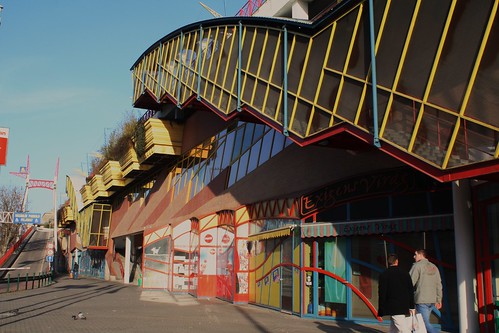
For a time in the early nineties new corporate and civic architecture had Duplo-bright exoskeletons and superplastic panelling coloured through in a palette of crayons. There are still remnants of this kind knocking around the UK in suburban business parks and less affluent parts of the town centre, though they look pretty bashful at being overdressed next to their mausoleum-in-smoked-glass counterparts.


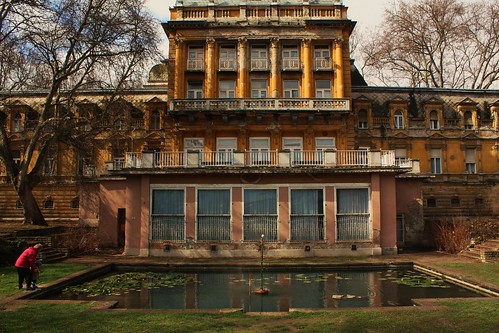
Budapest’s Lehel Csarnok, which I gather is locally thought of as something of an abomination (which well, it pretty marvellously is), is this stuff in excelsis:

ALPINE PURSUITS/ Life from the pages of a Modern Languages Textbook


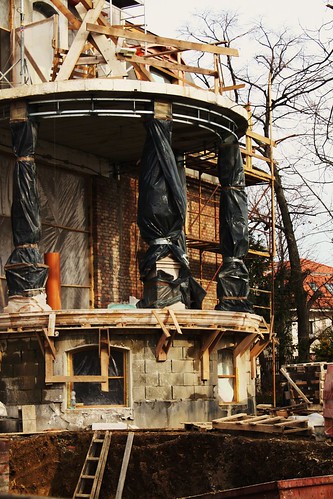
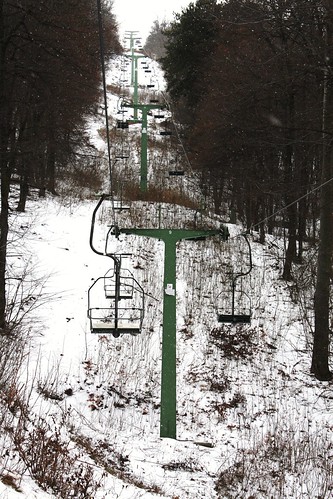
If I’m ever reincarnated as a person less wrapped up in books and more bent on commerce, I’d happily return, after a day’s pen-pushing, to one of District II’s neoclassical mansions. As it is, I just have to waft precariously past them as I’m hoiked up Janoshegy on a chairlift.


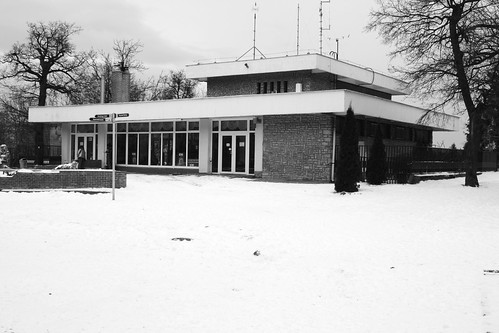
As a UKer more familiar with spending weekends going “up town” (despite being far away, I’m always keen to perserve the linguistic anomalies of Hullish), down the pub and perhaps for a quick redemptive sortie around the local park, I’m dead keen on Euro-style leisure habits. Weekends are much more wholesome here, some shops close after lunch on a Saturday and many head for the hills for outdoor pursuits. Though in downtown Pest its just a bit parky, at the top of the hill there were four inches of snow and Budapestis togged up in ski suits jogging, kids toting wooden sledges and (as it was Valentine’s Day) a fair few bashful teenage couples grabbing at oneanother’s be-mittened hands.