ART AND RELATABILITY/ Dóra Maurer at the Ludwig Museum Budapest

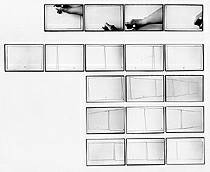
Relative Swings, 1973

I have a dreadful confession to make: I still don’t get visual art. This admission has been a long time coming, I think I first realised this whilst levitating past an advertisement for, you know, Caravaggio or something at the Haywood Gallery on an escalator in the London Underground some time in 2003.

Despite this I’m a regular gallery visitor; I find they provide good grist to the drift; the pacing, the silence and the squeak-squeak of rubber-soled shoes are unmatchable in encouraging thoughts to wonder. Although, perhaps in this sense none have matched the Toledo Museum of Modern Art: marked on maps and street signs, we arrived at an apartment block en el centro de la ciudad to find all the usual signs of an art museum – entrance, corridors, ticket office – but no galleries or exhibitions.

Anyway, frustrated and somewhat shamed by this I’m trying to find a way in. I’m as far as posturing as naif at this point; after all, about the sum total of my understanding currently rests on Hogarth and a long streak of the grotesque. Art Appreciation 101 stipulates it’s okay to laugh at the mischievous dog in the corner of the canvas, permits one to speculate on the knowing look in the sitter’s eye, fine to snigger at the aristo’s get-up to grasp towards a grasp that might be superficial, but at least it’s proper.

With all this in mind I took myself off to the Ludwig Museum, which relocated from its Buda Castle home to a industrial no man’s land turned cultural regeneration centre just north of Csepel some years ago. Though I’m pleased to note that their permanent collection of fairly tautological twentieth-century big hitters now includes selected Hungarian works, I was more interested in Limited Oeuvre, a retrospective of Budapest-born graphic artist Dóra Maurer.
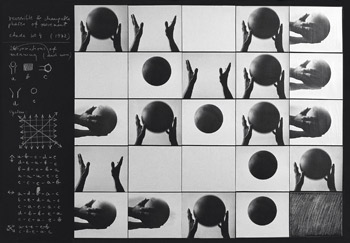
Etude 3

Modest conceptualist Maurer is into the the stuff of things. Her abstract geometries trust form’s own logic. Instead of privileging the action, she’s content to make her early intervention then allow forms to play.
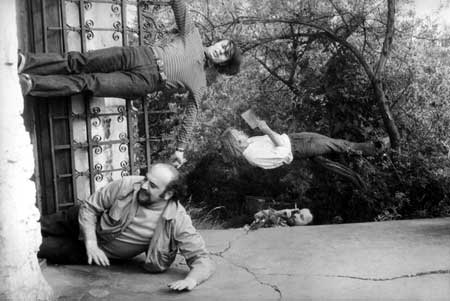
Once we had departed

Maurer’s graphics, photographs and films eschew representation in favour of the pleasures of form. She dirties graphic design and sullies mathematics to make neurotic investigations of proportion and seriality that not only emphasise the physical but also expand the remit of graphics to include traces and residues:

The craft of reproducible graphics, on the other hand, has an aura about it. Its materials have a fragrant smell, the work is a precise one that requires attention. It breaks down into phases, and the concentrated anticipation of what is not yet visible is a good feeling.

Overlappings, no. 16

Her recent Overlappings force geometry to dance. Maurer’s brightly coloured forms unfurl and overlap like washing in the wind or juggled hankerchiefs. These are forms that aspire towards non-materiality. They reflect, or perhaps parody, changes in the grammar of contemporary graphics, whose forms deny their nature, appear lighter-than-air or quasi-organic. Like the difference between the cover of Esquire magazine in 1972 and the Microsoft Vista operating system, say.
FROST/NIXON


Growing up in British cities, where the geography of a night out at the cinema is most likely to take you to an out-of-town Retail and Leisure Development and post-film drinks to a nearby franchised theme bar housed in a car park, seeing Frost/Nixon at Terez körút’s Muvesz Mozi felt like a most metropolitan night out.

The film is one of a recent crop that approaches its historical moment through broadcasting history, opening out a televisual event to give us a second look at the twentieth century. In a time where we’re more conscious than ever of media machinations and subterfuge, it’s both refreshing and heartening to watch these paeans to the power of television. Frost/Nixon is a love letter to the vigour and thrust of TV’s liberal, righteous origins. Though its plot eeks out the suspense of Frost’s team snatching victory from the jaws of defeat, what’s most significant isn’t Frost’s unexpected political nous or grilling technique, nor Nixon’s slippery evasions, but television itself. As screenwriter Peter Morgan admits in his Front Row interview on Radio Four, the real triumph is in the editing process, zooming and cropping Nixon’s derelict close-up.

In the end, however, the film is hoist by its own petard. After the first day of filming, where Frank Langella’s fantastically prunish and perspirant Nixon has derailed the interview with 23-minute homilies, Frost’s team warn him against the perils of humanising the former president. Via the screenwriters extra-factual additions (like Nixon’s drunk, self-pitying telephone call to Frost’s hotel suite), the film does just that.

Less vigourously and angrily political than Goodnight and Good Luck by far, then, but still an evocative period piece.

COOL, CLEAR WATER


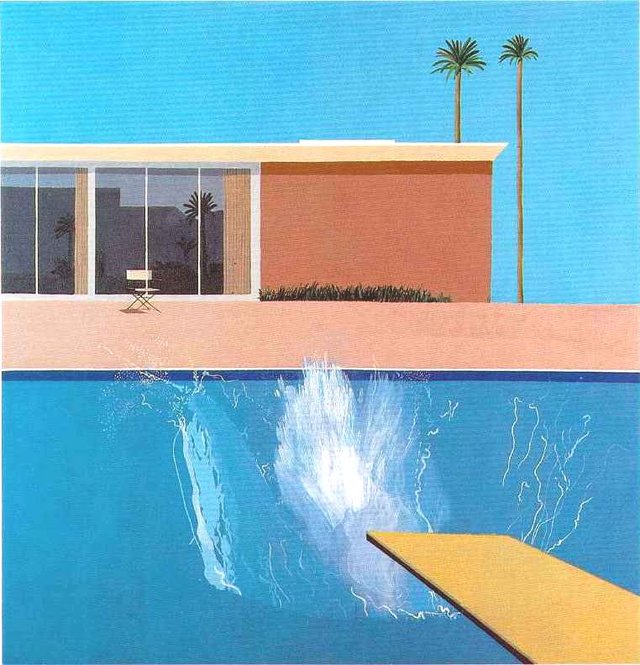
He found the closest thing to an abstract image in our world and a system of painting it as figuratively as possible.

Bryan Appleyard on David Hockney’s swimming pools, from The Pleasures of Peace. Appleyard has his own cheerful, intelligent blog here. In this book of his, subtitled ‘Art and the Imagination in Postwar Britain’ he grabs the reins of the historical forces of the period and manages to get them to play together rather beautifully. It’s a wonderful kick up the behind for someone whose own study of the period sometimes seems all-too-prone to whittle the really juicy stuff into dry bone.

IRE AND LAMÉ

During one of our semi-regular, Youtube-fuelled Britpop reunion parties, watching Sarah Cracknell attempting to rouse the crowd during Hug My Soul at Glastonbury 1994 got me thinking.

For a time, in the mid-nineties, St Etienne flirted with being a geniunely popular pop band. Bob Stanley, Professor Emeritus of pop, probably shoulda known better. Their blend of Italianate house, the BBC radiophonic workshop and kitchen sink drama could never quite leapfrog out of irony, become the loved rather than the love letter. Liverpool band Ladytron attempted the same manoeuvre a decade later, noting the success – from the opposite direction – of self-conscious pop bands like Girls Aloud and the Sugababes. Ladytron’s attempt to make a break for it was roughly concomitant with the muddleheaded critical second-guessing and pseudo-broad church of popism. This critical stance attempts a straight-faced appreciation of pop music, in and of itself, and – like Jeff Koon’s puppy – ends up obscuring the problem. Not familiar with the term? It’s just one of a number of fairly pervasive and bad faith journalistic (UK-style) co-options of low culture which tend to masquerade as the daredevil flouting of cultural hierachy. Ask k-punk or Owen Hatherley; they’re most sane and heartening on the subject.

THE VIEW FROM HERE

As an undergraduate, a large part of my imaginative life was taken up by foreys into Englishness, a pursuit both blessed and blighted by the tinge of juvenilia, like all the best obsessions are. Indeed, with the sureity that only a nineteen year-old can muster, it hadn’t occurred to me that many, many others were similarly busyied away, constructing their own imaginative landscapes to form a vast, collective hallucination of ice cream cones, film stills of Julie Christie, bunting, Sarah Cracknell’s smile, seaside piers on fire, bald patches and anaglypta wallpaper.

Having spent the five years since then systematically chipping away at an instinct, on coming here I had thought I was too ensconced for a long spell in Hungary to reshuffle my picture of England. I was wrong, however; from here England has begun to reorganise itself into a solid shape and the view doesn’t look too sprightly. What this amounts to, I’m not yet sure. In terms of my, ahem, literary pursuits it’s a very timely boon (confidential to those with a friendly interest in my meatworld: it’s just under three weeks ’til my PhD application is due), clearing much of the fog around the subject. In a wider sense, I’m far to innured to the perils of cultural relativism to begin to think comparatively about this fine, strange, new place yet. I’ll think on…

SUNDAY PROMENADE

Újlipótváros is fast becoming my favourite district of Budapest. Its grids loosely overlook Margit Sziget and shade from rough n’ ready to elegant and genteel as you edge closer to Parliament.

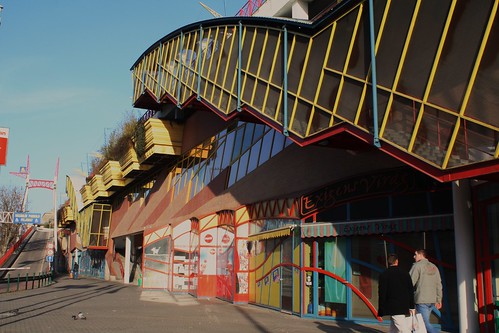
Lehel Csarnok

This marvellous place wasn’t giving up its secrets too readily on my fly-past. Google tells me it’s a market hall, built in controversial style to resemble a ship.

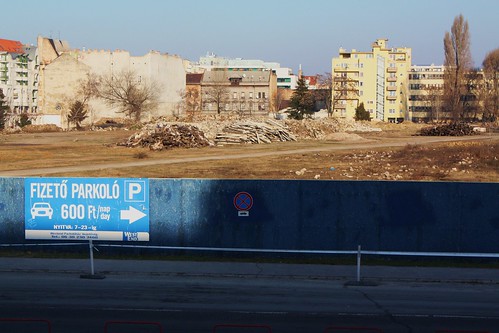
What lies beyond Nyugati Station.

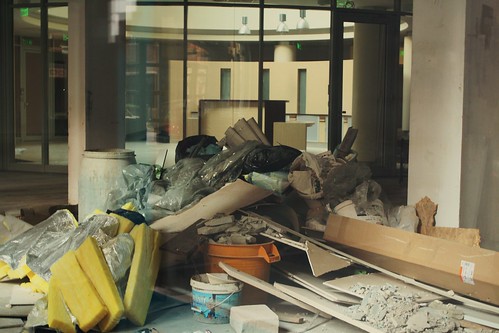
Construction work in Budapest works something along the lines of the painting of the Forth Bridge. From eight onwards on weekdays, the street of the VIIth (and indeed most other districts) are hemmed by chaps in overalls toting minature coffees and dragging on strong fags. Clearly here they’d knocked off in a hurry.

The weather here seems to have turned on a sixpence: after an early January of -7 degree maximums the last few sunny, smoggy days have me convinced that spring has sprung. It’s doubtful – freezing February will surely bite me on the bum – but for now, ice cream (that’s fagylalt) seems close.

THE HARD WEEK


A week of first drafts and deadlines and wobbles and interviews topped out last night with cake n’ beer at Muzeum Cukrászda and a Twin Peaks marathon*. Today was a virtual write-off, but is about to be redeemed with Frost/Nixon at the strange and beguiling Muvesz Cinema. For someone as slow off the mark as me, the lag between Anglo-American and Hungarian cinematic release dates is a real boon.

*Of which there is much to say, natch.

DUCKS IN THE MIST, A FILM STARRING SIGOURNEY WEAVER


Ever-mysterious, Budapest occasionally borders on the completely incomprehensible. Countering, we roam town concocting muddleheaded, bad-science rationale.

This isn’t smoke, or Budapest’s infamous smog: it’s steam rising from the duck pond at the City Park. Our explanations ranged from the park’s proximity to the Szechenyi Gyogyfurdo (that’s the orangeish neo-classical baths where old men play chess), to the heat emitted by the Millenium Metro (the oldest in mainland Europe) which runs underneath.